

By Marc Levy
Wednesday, October 8, 2025
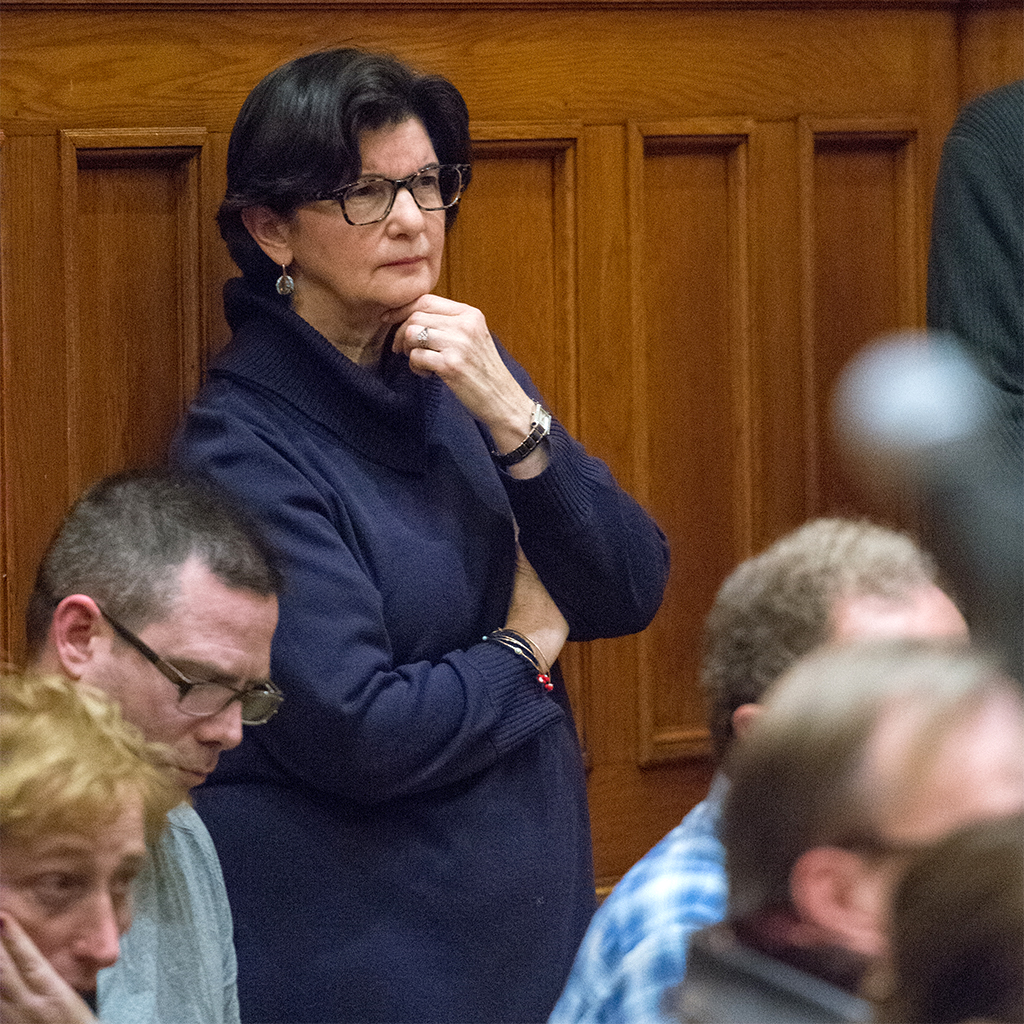
Ceilidh YurenkaDenise Jillson, executive director of the Harvard Square Business Association, at a City Council meeting in 2016.
The Cambridge City Council pushed pause Monday on a potential 22 percent hike in the commercial property tax rate, as city officials tried to ease concerns about the jump.
Councillor Paul Toner, who is not running for reelection, used his “charter right” to stop discussion, saying it would give the city “another two weeks for us to be able to let people settle down, absorb the information. Maybe the staff has a Zoom call with the business associations to answer their questions.” The decision is delayed until Oct. 20.
City manager Yi-An Huang welcomed the pause, acknowledging “a need to have engagement especially with the businesses that are saying, ‘Oh, this is a really high rate.’”
Huang, other staff and councillors had calming messages for commercial property owners about the proposed rate, which would shift to $14.07 from $11.52 per thousand dollars of assessed value. It was noted that total commercial property values fell by 11.5 percent based on market activity in 2024, which is studied to set property assessments for the current 2026 fiscal year. In contrast, total residential property values rose by 2.6 percent.
Values also varied across industry sectors, said Claire Spinner, assistant city manager for fiscal affairs. Laboratory space saw significant drops, while hotels did not, she said. That means an average increase in tax payments of 8 percent. “We are going to raise 8 percent more taxes, but how it will be felt across the class will be different,” Spinner said. She acknowledged some taxpayers “may indeed feel a 22 percent increase – if their value stayed exactly the same as last year and the rate increased by 22 percent.”
Restaurants and hotels will feel more of the brunt of the higher tax rate, retail somewhat less so, said Gayle Willett, the city’s director of assessment. Commercial property owners carry roughly two-thirds of Cambridge’s tax levy burden.
A staff memo for Monday’s hearing noted that even with a 22 percent increase, rates for Cambridge property owners – commercial and residential – remain the lowest in the area. Cambridge’s proposed $14.07 rate is below Brookline’s existing $16.56 rate, Newton’s $18.34, Somerville’s $18.92, Watertown’s $22.83 and Boston’s $25.96. Rates in those communities are likely to rise this year, staff noted.
City officials justified the proposed rate hikes by noting that it is contending with an economic downturn and federal hostility, so must both tighten its spending and lock down revenue. Cambridge’s $991.2 million budget, approved in June, was only 3.7 percent higher than last year’s; not long ago, annually there were “budget growth rates of 7, 8, 9 percent,” Huang said.
There’s a disconnect between a budget that rises only 3.7 percent and the higher property tax rate increases, Toner said, because the city has “to pay the bills for all the things we’ve accumulated over the years,” from universal prekindergarten to weekly recycling pickups.
Business struggles
The first public speaker on Monday was Denise Jillson, executive director of the Harvard Square Business Association, who called for the vote to be postponed. On Tuesday, though, she seemed resigned to the rate increase. “I don’t think they can reconsider it,” Jillson said. “But I’m grateful to have it to chew on for a couple of weeks, to talk about what this really means.” She said the hearing was “a wakeup call.”
Stuart Rothman of First Cambridge Realty would like to see conversations held with business owners and tenants. Most of his commercial tenants have pass-through leases that put them on the hook for increased property costs. “I’m not saying [the rate increase is] unreasonable or reasonable, but there should be a conversation about it,” he said.
Some businesses may leave, warned Ted Galante, an architect based in Cambridge for 28 years. Galante’s Architecture Studio leases space, and said even if Cambridge tax rates are low compared with its neighbors, a square foot of office space in Harvard Square is $60, versus $35 in Boston’s Post Office Square. He knows of a firm that just signed a lease that moves it out of Cambridge, and said he too was “very seriously considering a move.”
In her public comments Monday, Jillson warned that while the rate might seem to affect mainly “large, possibly faceless, corporate property owners,” it would still wind up hurting small family firms and businesses that were struggling.
The next day Jillson said she follows the council fairly closely but still was taken by surprise by the arrival of the tax rate hearing. “There’s so much coming at us all the time now,” Jillson said. “We’re overwhelmed.”